
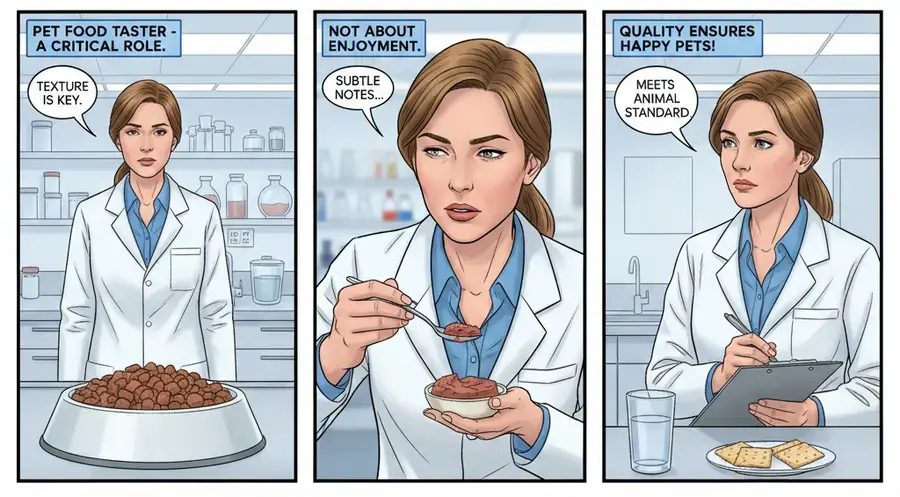
A pet food taster exists because companies need direct sensory feedback. Machines can measure nutrition and composition, but machines cannot judge flavor accuracy, mouthfeel, or whether a formula matches what an animal is expected to find appealing. The job is real, and the requirements are specific: a controlled palate, the ability to assess subtleties in texture, and a willingness to evaluate products never designed for human enjoyment. The focus keyword “pet food taster” defines the entire operation.
The position comes out of necessity. Pet owners expect consistency across every bag or can. That expectation forces brands to maintain strict sensory quality standards. A pet food taster operates inside those standards as the final human checkpoint. They assess aroma, note metallic aftertastes, identify rancidity early, and confirm product uniformity before distribution. This is not about eating full meals. It is about taking analytical bites for validation.
The history behind it is straightforward. Large-scale pet food manufacturing grew in the mid-20th century. As brands diversified product lines, they introduced new proteins, textures, and moisture levels. Companies realized that texture could swing consumer loyalty more than ingredients because animals respond to mouthfeel as strongly as scent. This pushed the industry toward more structured sensory panels. A pet food taster became a required participant in these evaluations.
The role follows a consistent structure. Testers prepare samples under strict sanitary conditions. They check aroma first. Off-smells indicate oxidation or contamination, and this phase alone rejects many batches. They then examine texture by pressing samples between their fingertips or tongue. Since texture is one of the most important features to animals, a tester must detect grittiness, excessive softness, or binding agent failure with high accuracy. Flavor assessment follows. The human pet food tasting job depends on discipline: tasting without swallowing, isolating component flavors, and comparing those notes to expected profiles.
The work depends on pattern recognition. A tester develops memory libraries of flavors across protein families, fat sources, and formulation styles. When a sample deviates, they can identify the cause quickly. This is how pet food testers evaluate flavor reliably in environments where chemical markers alone fail to capture sensory truth. Dry formulas carry different markers than wet varieties. Freeze-dried products behave differently after rehydration. A trained tester functions as a reference point across these categories.
The job requires strong detachment. Personal preference cannot influence assessment. A sample might be unpleasant to a human but perfect for an animal. The tester’s task is comparison to standard, not enjoyment. To maintain consistency, testers often follow palate-resetting routines between samples: water, plain crackers, or neutral foods that eliminate lingering flavors. This is identical to procedures used in wine, coffee, and tea evaluation fields.
Training is methodical. New testers begin with aroma identification and texture classification. Flavor evaluation comes last because it demands the highest tolerance and control. Companies test trainees using blind samples to verify accuracy. Those who cannot detect subtle changes do not advance. The field, while unusual, mirrors every other sensory-based quality control profession.
The pay structure varies. Established companies compensate testers at competitive rates because the role directly affects product consistency and consumer trust. Errors lead to recalls, brand damage, and negative customer perception. A pet food taster prevents these failures by catching problems early. The job sits at the intersection of food science and quality control careers, not entertainment or novelty.
The job’s existence often surprises people, but its logic is simple. Pets cannot communicate sensory issues. A human proxy fills that gap. Every major manufacturer uses trained testers or sensory panels because they cannot risk releasing inconsistent batches. As long as pet food production remains industrialized, the pet food taster remains a critical control point.
The larger takeaway is direct: the world contains functional roles that seem strange when viewed outside their context. This one exists because sensory data still depends on humans. A pet food taster works inside that constraint with straightforward purpose: verify quality, confirm consistency, and maintain standards that align with animal preferences, not personal ones.
