
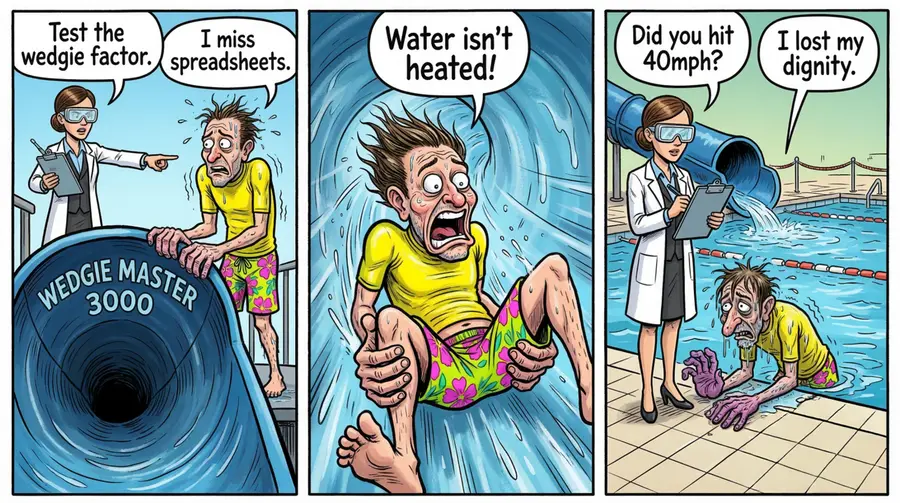
Have you ever stared blankly at a spreadsheet, nursing your third lukewarm coffee of the morning, and thought, There has to be a better way to pay rent? Well, prepare to have your current career choices completely demoralized. The role of a water slide tester isn’t just a myth told to children to make them eat their vegetables—it is a real, actual, tax-paying profession.
Instead of an ergonomic mesh chair, their office is a 300-foot fiberglass tube of terror. Instead of commuting through gridlock traffic, they commute via gravity, plummeting into a splash pool at 40 miles per hour. When people compile lists of the weirdest jobs in the world, this aquatic gig consistently floats to the top. But before you angrily quit your day job to become a human torpedo, you should know that there is actually a lot of science, safety, and chafing involved in the process.
Why Every Water Park Needs a Water Slide Tester
You might think that building a water slide involves snapping some plastic tubes together, adding a hose, and hoping for the best. In reality, modern water parks are engineering marvels that defy physics. We are no longer talking about the sad, sun-faded playground slides of our youth; we are talking about multi-story, looping, trap-door-dropping monstrosities.
Before a screaming tourist ever sets foot on a new aquatic behemoth, a water slide tester must ensure the ride complies with incredibly strict theme park safety regulations. This means someone has to be the literal guinea pig. Engineers can run all the computer simulations they want, calculating water flow rates, trajectory, and friction coefficients, but a digital stick figure can’t tell you if a slide’s seam is going to aggressively scrape your shoulder blades.
The tester is looking for three main things: safety, speed, and the overall “fun factor.”
Safety: Is the water volume correct, or are riders going to dry-slide and get stuck halfway down a pitch-black tube? Are the banked curves high enough to keep a human body inside the flume, or is there a risk of becoming airborne? (Spoiler alert: airborne is bad).
Speed: Does the ride deliver on its adrenaline promises? If a slide is marketed as a “death-defying plunge,” it can’t feel like a lazy river. Conversely, if it’s too fast, the G-forces could cause riders to black out.
The Fun Factor (and the Wedgie Parameter): A good tester rates the splashdown. They evaluate the adrenaline rush. They also take mental notes on the “wedgie parameter”—how aggressively the water flow attempts to turn your swimsuit into dental floss upon impact.
The Glamour (and the Prune Fingers) of the Job
The perks of being a professional water slide tester are obvious. You get paid to travel the globe, visiting luxury resorts in places like Turkey, Egypt, Jamaica, and Spain. You get VIP access to parks before they open to the public. You get to wear board shorts to your performance reviews.
But it’s not all sunshine and piña coladas. Imagine showing up to “the office” on a brisk, 50-degree Tuesday morning in November because a new park in the Midwest needs their slides certified before the spring thaw. The water heaters haven’t been turned on yet. You still have to test it.
Then there are the stairs. Oh, the stairs. Without the luxury of an elevator, a tester might climb the equivalent of the Empire State Building in a single afternoon, carrying a heavy inflatable raft the entire time. Add in the permanent state of prune-fingers, the unavoidable water up the nose, and the occasional friction burn from a misaligned fiberglass joint, and you realize this job requires serious physical stamina.
Wait, How to Become a Water Slide Tester?
If you’re currently ignoring your boss and furiously Googling “how to become a water slide tester,” you should know that it’s not exactly a position you’ll find listed on standard job boards.
Most of these coveted roles are created as brilliant PR stunts by major travel companies and resort chains. For example, the travel giant First Choice made headlines a few years ago when they posted a highly publicized opening for a tester, offering a $30,000 salary to travel the world for six months rating slides. Thousands applied, submitting video resumes proving their enthusiasm for extreme splashing.
Other times, testers are quietly employed directly by the engineering and manufacturing firms that design the rides, such as WhiteWater West or ProSlide. In these cases, the testers are often engineers themselves, combining a deep understanding of fluid dynamics with a high tolerance for getting soaked.
The Ultimate Splashdown
At the end of the day, the existence of the professional water slide tester is a comforting thought. It proves that within the rigid, hyper-regulated adult world of liability waivers and engineering blueprints, there is still room for professional-grade fun.
So, the next time you find yourself standing at the precipice of a terrifying, 10-story mega-slide, questioning your life choices as the water rushes past your toes, take a deep breath. Remember that somewhere out there, a dedicated professional in a highly resilient swimsuit took this exact plunge before you, sacrificing their dignity and their sinus cavities just to make sure you’d have a good time. Now cross your arms, lean back, and enjoy the ride.