
Brains, Brawn, and Blunders: Welcome to the Wild World of Chess Boxing
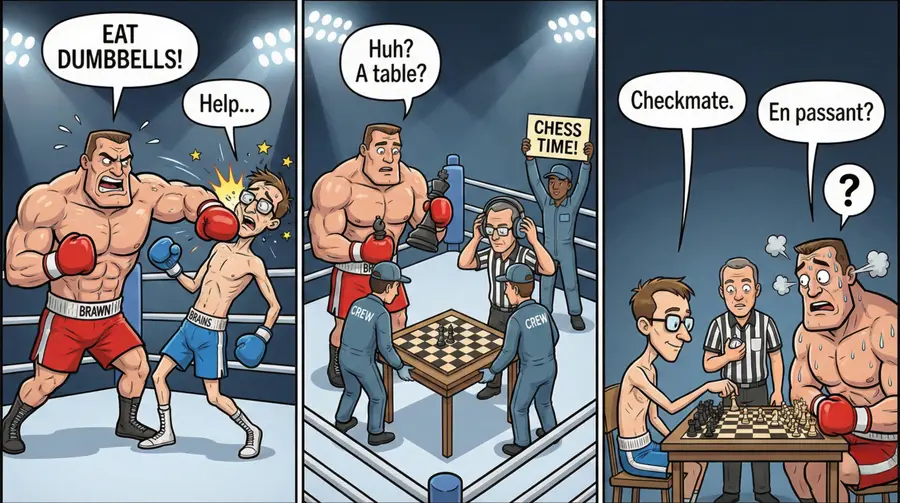
Let’s paint a picture. You’re standing under the glaring lights of a dimly lit, smoke-filled arena. The bell rings. You have just survived three excruciating minutes of taking heavy leather to the jaw from a guy who looks like he eats dumbbells for breakfast. Your heart is pounding at 180 beats per minute, your vision is blurry, and your gloves are soaked in sweat. The referee steps in, breaking you apart.
Does he raise your hand? Does your cornerman toss you a water bottle and a towel? No. A crew rushes in, drops a table in the center of the ring, slaps a pair of noise-canceling headphones over your bleeding ears, and tells you it’s your turn to move your bishop.
Welcome to the spectacularly bizarre universe of chess boxing, the only athletic competition on planet Earth where you can literally get your bell rung and then lose the match because you forgot how the en passant rule works.
For the uninitiated, chess boxing sounds like a punchline, or maybe an AI prompt gone horribly wrong. But it is not a joke. It is a grueling, fiercely competitive endeavor that demands an absolutely unhinged level of physical and mental endurance.
The Bizarre Rules of Chess Boxing
The premise is brilliantly simple. Competitors alternate between three-minute rounds of fast-paced speed chess and three-minute rounds of traditional boxing. A full match consists of 11 rounds (six of chess, five of boxing) with sixty-second breaks in between to frantically rip off or strap on gloves.
If you’re wondering how to win at chess boxing, the paths to victory are as dual-natured as the sport itself. You can end the match with a traditional knockout in the ring, a devastating checkmate on the board, a judge’s decision, or a time penalty if your opponent’s chess clock runs out. There is no coasting here. You cannot just be a meathead with a mean right hook, nor can you be a grandmaster with a glass jaw. You have to be a lethal, terrifying combination of Mike Tyson and Magnus Carlsen.
The Origins of Chess Boxing in Berlin
But how did this glorious madness actually start? You might assume it was dreamed up in a frat house after a weekend bender, but the true origins of chess boxing in Berlin are far more artistic. The concept actually debuted in a 1992 French science fiction comic book called Froid Équateur (Cold Equator) by Enki Bilal.
Fast forward to 2003, and a Dutch performance artist named Iepe Rubingh decided the comic was simply too good to stay confined to the page. Rubingh brought the concept to life, organizing the very first official bout in Berlin, Germany. What started as an avant-garde performance art piece instantly captivated the public. It was weird, it was violent, it was incredibly smart. Soon after, the World Chess Boxing Organization (WCBO) was formed, and a legitimate global sport was born.
The Ultimate Biological Challenge
Today, it sits proudly at the absolute top of the list of the weirdest hybrid sports in the world. But the “weirdness” masks a profound, almost sadistic physiological challenge.
Consider what happens to the human body during a fistfight. Your adrenal glands dump massive amounts of adrenaline into your bloodstream. Your fight-or-flight response takes full control, prioritizing gross motor skills and raw survival over complex logic. Blood is quite literally routed away from the prefrontal cortex—the part of the brain responsible for deep analytical thinking—and sent to your muscles.
Now, imagine sitting down to calculate a five-move tactical combination while your body is actively screaming at you that a predator is trying to kill you. When a chess boxer sits at the board after a boxing round, they have to forcefully wrangle their sympathetic nervous system. They wear those giant noise-canceling headphones to drown out a roaring crowd, stare intensely at 64 black-and-white squares, and try to lower their heart rate on command. It’s an exercise in extreme biofeedback.
And you can’t just stall on the board to catch your breath. Both fighters share a strict, ticking 9-minute chess clock for the entire match. If you stare blankly at your knights while trying to remember your own name, your clock will run out, and you lose. A single lapse in concentration, brought on by exhaustion or a solid left hook from the previous round, can lead to a game-ending blunder.
Attending a live event is an exercise in psychological whiplash. For three minutes, the crowd is screaming for blood, cheering every jab and uppercut. Then the bell rings, the announcer yells for silence, and the arena suddenly behaves like they are watching center court at Wimbledon. The juxtaposition is hilarious, electric, and utterly fascinating.
In a modern world where sports are increasingly hyper-specialized, chess boxing dares to ask: “Why not both?” It demands the ultimate synthesis of physical endurance and cognitive mastery. So, the next time you’re feeling proud of yourself for completing a Wordle while walking on the treadmill, remember the chess boxers. They’re out there, taking punches to the face, wiping the blood from their eyes, and calmly whispering, “Checkmate.”