
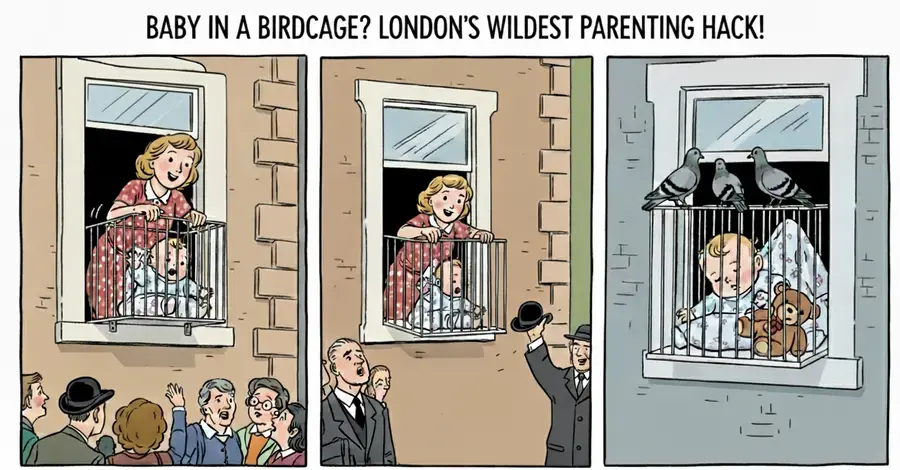
Picture this: you’re strolling through 1930s London, glance up at a row of flats, and there it is—a baby, dangling outside a fourth-story window in what looks like a wire birdcage. No, this isn’t a lost page from a dystopian novel. This was an actual parenting invention known as the “Baby Cage.”
Yes, folks, once upon a time, people thought the best way to toughen up infants was to stick them in a glorified balcony chicken coop and leave them hanging over city traffic. Because nothing says “healthy childhood development” quite like dangling over cobblestones and horse-drawn carriages.
The Rise of the Window Crib
The Baby Cage wasn’t a fringe oddity cooked up by eccentric uncles in sheds—it was a patented product. In 1922, a woman named Emma Read of Washington, D.C., filed a U.S. patent for what she called a “portable baby cage.” By the 1930s, the idea had hopped the pond to London, where high-rise living was on the rise but balconies were a luxury. Urban parents, desperate for sunlight and fresh air for their little ones, saw this as the perfect solution.
The setup was simple: a wire cage, large enough to fit a wriggly infant, attached directly to a window frame. The baby got a breezy outdoor nap, and the parents got… well, probably less peace of mind than advertised.
But… Why?
Before you call Child Protective Services retroactively, let’s remember that this was the era when people thought cod liver oil cured everything from rickets to bad vibes. Doctors at the time believed fresh air was essential for health, especially in grimy, coal-smoked cities.
Apartment dwellers without backyards had few options. Taking the baby outside was a hassle. Building codes weren’t exactly playground-friendly. And so, some clever (or wildly reckless, depending on your perspective) minds thought: “Why not just hang the baby out the window?”
Even organizations like the Chelsea Baby Club in London reportedly distributed Baby Cages to members. Imagine opening your welcome kit and finding a window-sized death trap inside. Cheers, mate!
Public Reaction: Curiosity Meets Terror
Newspapers from the 1930s ran cheery photos of babies happily chilling in their sky-high cages, bundled in blankets with a pacifier. But you have to wonder: did neighbors really stroll past thinking, “Ah, what a modern solution!” Or was it more like, “Dear lord, Susan’s put little Timmy in the pigeon loft again.”
Not everyone was on board. Some city officials raised safety concerns (because, shockingly, babies aren’t known for staying put). Others simply thought it looked horrifying. One can only imagine the heart attacks it caused in visiting grandparents.
The Slow Death of the Cage Craze
By the 1950s, the Baby Cage was going the way of the lobotomy and asbestos toys—quietly shuffled off the shelf of “bad ideas we used to think were genius.” Advances in child psychology, stricter building codes, and, let’s be honest, common sense all conspired to make the contraption obsolete.
Plus, the rise of strollers, playpens, and parks gave parents less terrifying ways to get some air. Eventually, the Baby Cage became a quirky footnote in the long history of parenting fads, right up there with whiskey as a teething remedy and lead paint as nursery décor.
So, What’s the Takeaway?
If you think modern parenting fads are weird—baby yoga, placenta smoothies, Bluetooth baby monitors—remember that less than a century ago, parents casually suspended infants in birdcages above busy London streets.
The Baby Cage is a strange reminder that every generation has its own idea of “good parenting,” and future folks will probably laugh (or cry) at ours too. So before we mock, maybe ask: which of today’s trendy gadgets will look like a death trap in 80 years? (I’m looking at you, baby helmets for “flat head syndrome.”)
For now, let’s just be grateful that babies these days are chilling in car seats and strollers, not dangling over traffic like canaries in a coal mine.
