
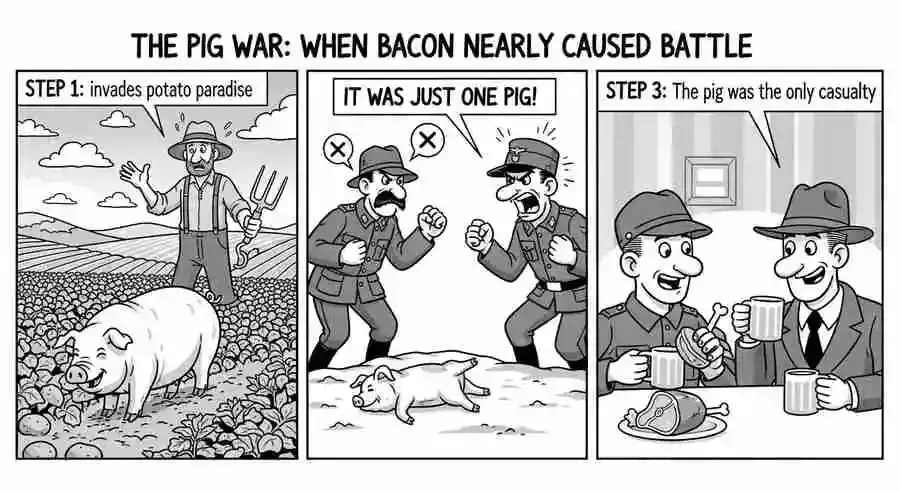
Picture this: two mighty empires—the United States and Great Britain—eyeing each other suspiciously across a misty stretch of Pacific Northwest islands in 1859. Tensions are already simmering, maps are confusing, and sovereignty is murky. Suddenly, someone pulls the trigger. But here’s the plot twist: the only casualty is… a pig. Yep, a single porker munching on the wrong potato patch nearly dragged two world powers into open war. Forget assassinated archdukes—this was bacon diplomacy gone wrong.
The Spark: A Pig with a Potato Problem
It all began on San Juan Island, a scenic chunk of land between Vancouver Island and the U.S. mainland. American settlers lived there, rubbing elbows with employees of the Hudson’s Bay Company (a British fur-trading powerhouse). Border disputes had been simmering for years because the treaty that divided U.S. and British territory in 1846 was, let’s just say, about as clear as a foggy London morning.
Then came June 15, 1859. Lyman Cutlar, an American farmer, discovered a large black pig rooting through his potato garden. The pig belonged to Charles Griffin, an Irish employee of the Hudson’s Bay Company who let his animals roam freely. This wasn’t their first spud-heist, and Cutlar had finally had enough. He shot the pig.
In his defense, Cutlar offered to pay Griffin $10 for the loss. Griffin, however, demanded $100. (That’s about $3,500 in today’s money—apparently pork was premium.) The two men squabbled, and soon enough, both the American settlers and the British authorities were involved. Suddenly, one dead pig had turned into a full-blown international crisis.
Troops, Gunboats, and “Really, Over a Pig?”
When word spread, the Americans called for military protection. The U.S. Army sent in Captain George Pickett—yes, that Pickett, who would later be famous for Pickett’s Charge at Gettysburg. Pickett arrived with a company of soldiers and declared that no British subject would be allowed to remove an American citizen from San Juan Island. Bold move.
Not to be outdone, the British sent three warships bristling with cannons. Soon, nearly 500 American soldiers and five British warships were staring each other down across the water, each side waiting for the other to blink. Locals probably wondered if the island was about to turn into one giant battlefield.
And yet, despite the saber-rattling, cooler heads prevailed. Both sides realized how ridiculous it would be to spill blood over a potato-loving pig. General Winfield Scott, a U.S. military legend, personally sailed in to smooth things over. Together with British officials, he brokered a deal: joint military occupation. For the next 12 years, both nations peacefully cohabited the island, each keeping a small garrison there—one American, one British. The soldiers got along so well that they held sports games and invited each other to parties. The Pig War turned into more of a Pig Picnic.
Why This Even Happened
The deeper “why” here is equal parts geopolitics and absurdity. The U.S. and Britain were both flexing their muscles, eager to show dominance in the Pacific Northwest. Neither wanted to look weak. But neither wanted to ignite a full-scale war, either—especially not over livestock.
So the pig became the perfect scapegoat. By focusing their outrage on one squealing intruder, both nations could puff their chests without actually drawing blood. The incident also showed just how fragile borders were in the 19th century, when treaties were vague, maps were incomplete, and the concept of “whose potato patch is whose” could become an international flashpoint.
In the end, arbitration by Germany’s Kaiser Wilhelm I settled the dispute in 1872, declaring the San Juan Islands American territory. The pig remained the only casualty.
The Takeaway: Bacon Nearly Triggered Bayonets
The Pig War is a reminder that history isn’t always about grand battles or noble causes. Sometimes it’s about small, absurd moments spiraling out of control. A farmer defending his spuds, a pig with bad timing, and two empires unwilling to lose face—together, they created one of the weirdest “almost-wars” in history.
So next time someone tells you “don’t sweat the small stuff,” remember: the small stuff once nearly started a war between the United States and Britain. All because of a pig with a potato craving.
