The Best Job You’ll Never Get: Inside the High-Stakes World of Professional Sitting
Close your eyes and imagine your dream job. Does it involve a corner office? A company car? High-level corporate espionage? Now, be honest with yourself: does it actually just involve your pajamas, a very soft cushion, and the permission to do absolutely nothing for eight hours?
If you chose the latter, congratulations—you have the soul of a professional furniture tester.
While the rest of us are out here drinking lukewarm coffee and staring at spreadsheets until our retinas burn, there is a select group of elite humans whose literal job description is “to vibe.” They are the Olympic athletes of indolence, the scholars of the sofa, and the grandmasters of the nap. But before you quit your day job to become a full-time human ottoman, you should know that professional sitting is a lot weirder (and more scientific) than you think.
The Science of the “Butt-Feel”
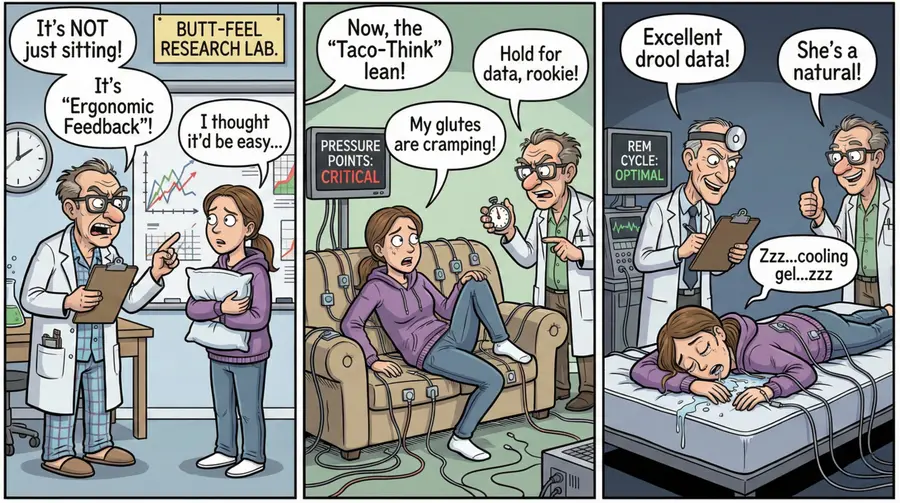
In the industry, they don’t just call it “sitting.” That’s for amateurs. Professionals talk about “ergonomic feedback” and “pressure point distribution.” When a professional furniture tester clocks in, they aren’t just lounging; they are conducting a high-stakes sensory audit.
Manufacturers spend millions of dollars developing the perfect foam density, but machines can only tell you so much. A hydraulic piston can pummel a sofa 50,000 times to simulate ten years of use—this is a key part of the furniture durability testing process—but a piston doesn’t have a nervous system. A piston doesn’t know if a fabric feels “scratchy” after an hour of Netflix. A piston doesn’t know if a cushion “swallows” you in a way that makes getting up to get a snack feel like an impossible feat of physics.
That’s where the humans come in. These testers have to evaluate everything from the “hand” of the fabric (how it feels to the touch) to the “loft” of the pillows. They have to sit in various positions: the “slump,” the “perch,” the “I’m pretending to listen to my spouse but I’m actually thinking about tacos” lean. It’s exhaustive work for the gluteus maximus.
Getting Paid to Dream
If sitting on a sofa sounds too strenuous, there is a sub-sect of this profession that focuses entirely on the horizontal: the mattress tester. Yes, you can literally get paid to sleep on mattresses.
Companies like Casper, Sealy, and even high-end luxury brands hire “sleep interns” or “comfort researchers” to test out new prototypes. These lucky ducks are often wired up to heart rate monitors and sleep-tracking software to see how a specific memory foam affects their REM cycles.
Imagine your boss walking in, seeing you face-down on a bed, drooling slightly, and instead of firing you, they whisper, “Keep up the good work, Jenkins. Your data on the cooling gel is invaluable.” It’s the kind of professional validation most of us only see in a fever dream. However, it’s not all sweet dreams; these testers often have to sleep in controlled environments (read: creepy labs) and write detailed reports on their “sleep onset latency.” It turns out, even napping becomes a chore when you have to document your dreams in a spreadsheet.
How Do You Enter the Pro-Sitting Circuit?
You’re probably wondering how to become a professional sitter. Is there a degree? A certification in Recliner Studies?
The truth is, these jobs are rarer than a unicorn at a DMV. Most furniture testers are actually quality control engineers or designers who specialize in ergonomics. However, occasionally, companies will launch “Dream Job” marketing campaigns. In 2013, a student named Natalie Thomas was famously hired as a “bed warmer” for a hotel chain, where her job was literally to roll around in beds to make them cozy for guests.
To land a gig like this, you need more than just a lazy disposition. You need an incredible attention to detail. You need to be able to describe the difference between “plush,” “supple,” and “squishy” without using the word “comfy.” You need a “sensitive” backside that can detect a stray spring from a mile away, like a modern-day Princess and the Pea.
The Dark Side of the Ottoman
Let’s be real: there are downsides. Imagine having to sit on a bad chair for eight hours. A chair that was designed by someone who clearly hates human anatomy. A chair that makes your legs go numb in four minutes. That is the sacrifice a professional furniture tester makes for the greater good. They sit in the bad chairs so you don’t have to. They endure the “industrial-strength” polyester that feels like sandpaper so that your living room remains a sanctuary.
The Takeaway
The next time you sink into your favorite armchair and let out a sigh of relief, take a second to thank the anonymous professional who sat there first. Somewhere in a brightly lit factory, someone is currently getting paid to aggressively nap on a sectional, all in the name of science.
The world is a weird, wonderful place, and as long as humans have butts, we will need brave heroes to find the perfect place to put them. Now, if you’ll excuse me, I have some “independent research” to conduct on my own couch. For science, obviously.