
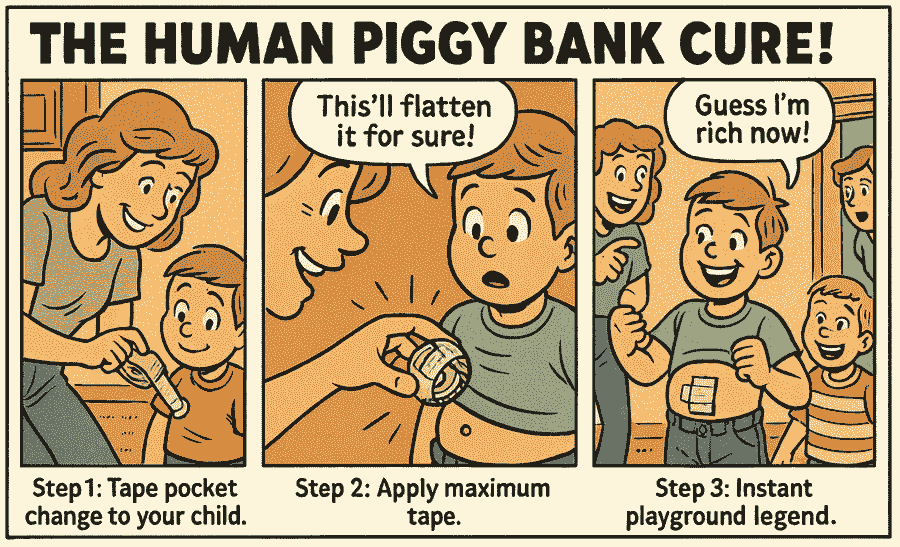
If you were a kid in the 1970s with an “outie” belly button, there’s a good chance your parents didn’t call a doctor—they raided the junk drawer for spare change and a roll of tape. That’s right: some families genuinely believed that slapping a nickel, dime, or even a quarter onto your navel and taping it down would magically flatten that pesky protrusion into a “proper” innie.
It sounds like a rejected plotline from a sitcom—“My Kid, the Human Piggy Bank”—but this belly-button hack was surprisingly common. And yes, parents proudly swore it worked.
Why Tape Change to a Child?
The theory was simple, if not entirely logical: belly buttons are basically scars from the umbilical cord. Some heal inward (the coveted innie), others outward (the oft-maligned outie). For reasons rooted more in vanity than medicine, outies were seen as odd or “imperfect.”
So, the coin cure was born. A flat, circular object pressed against the navel, held in place with surgical tape, was supposed to “train” the skin to grow inward. Kind of like braces for your belly button, except instead of a licensed orthodontist, you had Aunt Linda with a quarter and a roll of Scotch tape.
How Did This Start?
The practice has roots far older than disco-era America. In fact, belly button coin-taping has shown up in folk remedies across cultures for centuries. Some traditional Chinese practices involved placing coins or flat objects on the navel of infants, not just for aesthetics but also as a way to “balance the body’s energy.” Meanwhile, in parts of Latin America, mothers would tape down a coin or button to prevent what they called a “hernia.”
By the time the 1970s rolled around, the idea had been passed down through grandmothers and cousins as kitchen-table wisdom. Combine that with a cultural obsession for smooth, flat stomachs (thank you, Jane Fonda aerobics tapes) and suddenly, thousands of kids were walking around jingling faintly with taped nickels.
Did It Actually Work?
Here’s the kicker: not really. Outie belly buttons are usually caused by extra scar tissue or a small umbilical hernia. Taping a coin won’t change the anatomy underneath the skin. In other words, you weren’t turning an outie into an innie—you were just turning your belly into a sticky mess.
But the placebo effect is powerful. Parents swore they saw results, though it’s more likely the belly button was going to flatten naturally as the child grew—or maybe they just forgot what the belly looked like before the tape marathon began.
Medical experts have since confirmed: coin therapy is about as effective as putting a Band-Aid on a Wi-Fi router. No harm done, but no miracles either.
The Cultural Comedy of Belly Buttons
The whole saga says more about cultural hang-ups than anything else. Americans in the ’70s were oddly obsessed with belly buttons. Think about it: belly-baring fashion exploded (crop tops, halter tops, bikinis), TV famously censored Barbara Eden’s I Dream of Jeannie belly button, and yet people were desperate to make sure their kid didn’t grow up with a little nub poking out.
It’s weirdly poetic that something as tiny and harmless as an outie inspired so much parental anxiety—and so many taped nickels. Imagine explaining this to a modern kid: “Back in my day, if you had a weird belly button, your mom turned you into a vending machine.”
From Home Remedy to Odd History
Today, the coin-on-the-navel cure has mostly faded into the vault of forgotten folk medicine, alongside butter-on-burns and mustard plasters. Modern parents are far more likely to Google “should I worry about my baby’s belly button?” than grab spare change from the sofa cushions.
But the story lives on as one of those “can you believe this?” gems from recent history—a reminder that the line between folk wisdom and sheer silliness is often thinner than a strip of medical tape.
The Takeaway
The 1970s coin cure didn’t flatten outies, but it did flatten one truth: people will go to hilariously strange lengths to “fix” something that wasn’t broken in the first place. Belly buttons are quirky by design, whether innie, outie, or somewhere in-between. So the next time you catch a glimpse of your navel, just be glad no one’s trying to tape spare change to it.
