
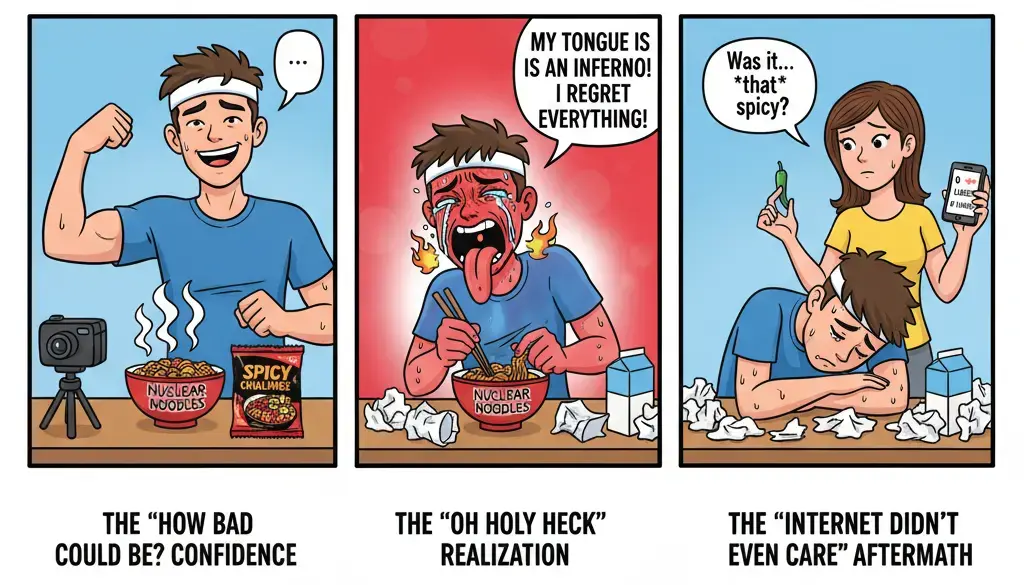
You know that feeling when your mouth is on fire, your nose is running, and you’re pretty sure your soul is trying to escape through your tear ducts? Yeah, me too. But while most of us would reach for a gallon of milk and a pint of ice cream, a whole generation of internet daredevils looked at that exact feeling and thought, “Let’s film it!”
Welcome to the glorious, terrifying, and utterly absurd world of the Korean Fire Noodle Challenge.
The Noodle of a Thousand Screams 🌶️
Back in 2014, while the rest of us were still busy with the Ice Bucket Challenge, a culinary wildfire was sparking up in South Korea. The culprit? A seemingly innocent packet of instant noodles from a company called Samyang Foods. But these weren’t your grandma’s chicken-flavored noodles. Oh no. These were the Buldak Bokkeum Myeon—literally, “Fire Chicken Stir-Fried Noodles.”
The secret weapon? A sauce packet so red it looked like it was cooked in the fires of Mount Doom. The noodles themselves were just the vehicle for a flavor that can only be described as a delicious, agonizing punch to the taste buds. And once a handful of Korean YouTubers decided to showcase their pain for the masses, a legend was born. It was an instant hit—a painful, glorious, and tear-soaked hit.
The Weird Science of Painful Pleasure
So, why would anyone willingly put themselves through this? The answer lies in a strange mix of biology, psychology, and good old-fashioned internet clout.
First, let’s talk science. The heat in those noodles comes from capsaicin, the active compound in chili peppers. When capsaicin hits your tongue, it doesn’t actually burn you. Instead, it tricks your pain receptors into thinking you’ve made a terrible life choice. Your brain gets the signal, “Hey, we’re on fire down here!” and responds with a full-blown panic attack: sweating, tear production, and a rush of endorphins. Yep, your body’s natural painkillers kick in to numb the perceived pain. That’s right, you’re basically getting a little runner’s high from eating spicy noodles. It’s the ultimate paradox: the pain is the pleasure.
But there’s more to it than just a chemical rush. This wasn’t just a solo mission; it was a challenge. The format was perfect for YouTube. It was short, visually dramatic, and had a clear “winner” (the one who finished the bowl without collapsing). Plus, it was highly relatable. Everyone knows the feeling of eating something too hot. The challenge turned a mundane meal into a spectacle of human endurance. It became a a rite of passage, a badge of honor in the digital sphere. People weren’t just eating noodles; they were proving their mettle to a global audience.
A Noodle-Fueled Revolution 🍜
The Korean Fire Noodle Challenge didn’t just sell millions of packets of noodles; it changed the game for viral trends. It was a prime example of a brand-driven, user-generated phenomenon. Samyang Foods didn’t have to launch a multi-million dollar ad campaign; their product was the ad. The spicy noodles went from a niche Korean snack to a global sensation, popping up on grocery store shelves everywhere.
It’s a testament to the power of the internet—how a single, ridiculously spicy food item could transcend cultural and geographic boundaries. From London to Los Angeles, people were sharing their fiery journeys, their teary eyes, and their surprisingly high tolerance for pain. It became a strange, universal language of suffering and success, all thanks to a packet of noodles and a whole lot of capsaicin.
So, the next time you see a challenge sweeping the internet, remember the noodles that started it all. It wasn’t just about eating something spicy; it was about the shared experience of pain and the sweet, sweet taste of victory. And probably a lot of milk. Because let’s be real, you’re gonna need it. 🥛
The Absurd, Fiery History of the Korean Fire Noodle Challenge
562
