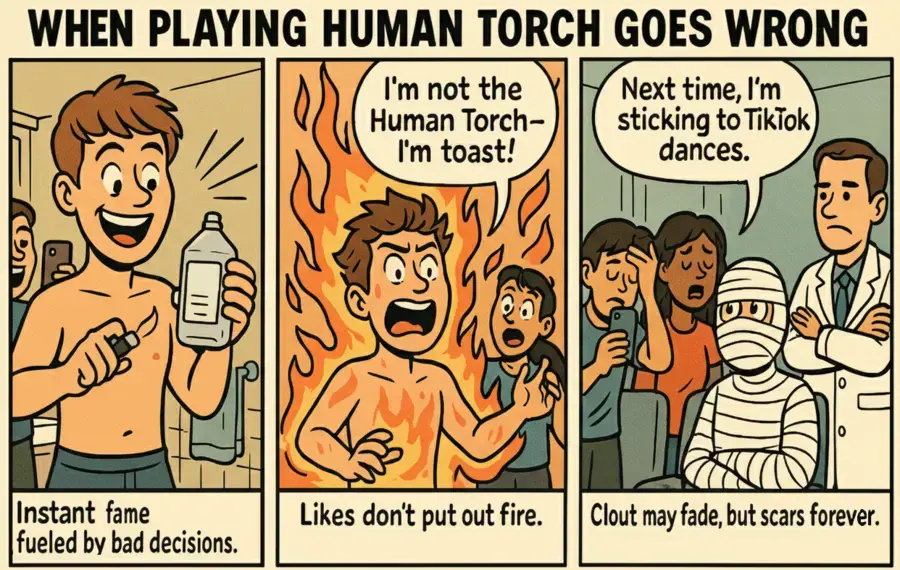
Picture this: you’re scrolling through social media in 2014, and up pops a video of a teenager dousing themselves in rubbing alcohol, striking a lighter, and instantly becoming a budget stunt double from The Human Torch. Before you can even process what’s happening, they’re flailing around trying to pat the flames out while their friends film and laugh in the background. No, this isn’t the rejected audition tape for Jackass. This was the Fire Challenge—an internet trend that was equal parts viral spectacle and Darwin Award audition.
Wait, People Actually Lit Themselves on Fire?
Yes. On purpose.
The Fire Challenge was one of those baffling internet fads where young people, fueled by boredom, bravado, and maybe a little too much Monster Energy, decided that the best way to rack up likes was to literally set themselves ablaze. The setup was simple: pour rubbing alcohol (or another flammable liquid) on your chest or arms, light it up, and then try to extinguish it before you roasted like a marshmallow.
Doctors in the U.S. quickly started sounding alarms as emergency rooms filled with teens sporting serious burns. Hospitals from Kentucky to California reported dozens of cases in just a few months. Some victims suffered second- and third-degree burns—injuries that weren’t just painful but required skin grafts and left permanent scars.
And all of this for… what, exactly? Bragging rights? A shot at viral fame? Or maybe just the twisted logic of the internet where, if something seems like a bad idea, there’s a guaranteed audience for it.
Why Did This Catch Fire (Pun Absolutely Intended)?
Like many internet challenges, the Fire Challenge spread thanks to a perfect storm of social media algorithms and teenage psychology.
First, there’s the daredevil factor. Every generation has its thrill-seeking stunts. Our parents might’ve jumped off rooftops into pools. Their parents might’ve seen how many people could fit into a phone booth. But with the rise of YouTube, Vine, and Facebook in the early 2010s, the stakes skyrocketed. Suddenly, you weren’t just impressing your friends—you could impress the whole world.
Second, there’s the illusion of control. Many teens thought fire was “easy” to manage: light it, let it burn for a few seconds, then smother it. What they didn’t account for is that rubbing alcohol burns fast and hot, spreading quicker than they could react. Once those flames touched clothing or skin, things escalated from “funny video” to “call 911” in seconds.
And finally, there’s the internet’s love of chaos. The more shocking, the more dangerous, the more likely it was to be shared. The Fire Challenge wasn’t about creativity or skill—it was about one-upping the last person’s recklessness.
The Fallout (Literal and Figurative)
Medical professionals were horrified. Burn units across the U.S. began publicly pleading with parents and schools to talk to kids about the dangers of fire. One doctor even compared the challenge to “playing Russian roulette with matches.”
Meanwhile, news outlets had a field day. Local stations aired dramatic clips of scorched teens alongside stern warnings. National outlets debated whether kids had lost their minds or if social media was the real culprit. It became a symbol of the “dumb things kids do for the internet,” a dubious club that also includes the Cinnamon Challenge, the Tide Pod Challenge, and that time people thought swallowing spoonfuls of nutmeg would lead to enlightenment instead of vomiting.
So, What’s the Lesson Here?
The Fire Challenge burned bright and burned out (thankfully) within the same year, but its legacy remains as a fiery cautionary tale. It taught us that virality doesn’t equal value, that teenagers plus flammable liquids equals disaster, and that maybe—just maybe—we shouldn’t take health advice from people filming with a shaky iPhone 4 in their mom’s bathroom.
The next time you see an internet challenge pop up, ask yourself: “Will this land me in the ER with bandages and a stern lecture from my doctor?” If the answer is yes, maybe stick to dance trends. TikTok has plenty of them, and the only thing you’ll burn is your dignity.
Takeaway
The Fire Challenge proved that the internet can turn even the dumbest idea into a viral phenomenon. But it also reminded us that actions have consequences—and fire, unlike your online clout, doesn’t care about likes.
So if you ever feel tempted by the latest internet stunt, remember: you can’t go viral if you’re in the burn unit.
