
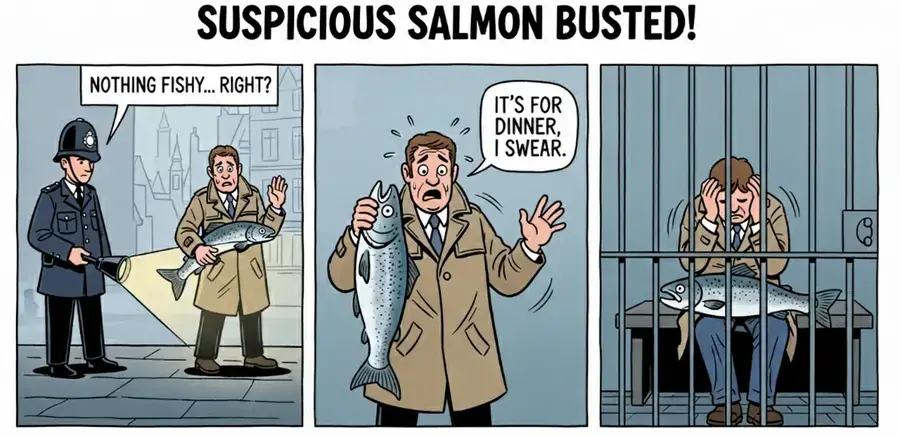
Imagine this: you’re at the grocery store, strolling past the seafood counter, when suddenly you hear a whisper: “Psst, that salmon looks shady.” No, you’re not losing your mind. You’ve just stumbled into one of the strangest corners of legal history: the infamous “Suspicious Salmon” law.
Yes, at one point, governments actually drafted rules that treated salmon like undercover criminals. So, let’s dive headfirst into this fishy business.
A Law Straight Out of a Monty Python Sketch
Back in the mid-20th century in the U.K., there was a clause buried inside the Salmon Act of 1986 that made it illegal to handle salmon in “suspicious circumstances.” That’s right—forget jewel heists or bank robberies. If you had a salmon and it looked even a little bit off, you could technically get in trouble with the law.
Picture a police officer patting you down and finding a fish in your coat pocket.“Care to explain why you’ve got this salmon, sir?”“Uh… dinner?”“Suspicious.” Slaps on the cuffs.
Why Were Salmon Considered Criminal Masterminds?
Okay, so what’s the deal? Why single out salmon?
The answer lies in one word: poaching. Not the eggs-and-water kind, but the illegal fishing trade. During the 20th century, salmon was highly prized and fetched a serious price on the black market. Smugglers, fish thieves, and shady dealers were moving illicit salmon around like contraband diamonds. The government needed a legal tool to catch them in the act.
So they came up with a catch-all rule: if someone was caught with a salmon in circumstances that couldn’t be reasonably explained, the law could swoop in. Think of it as “possession with intent to grill… suspiciously.”
The Odd Specificity of British Law
Britain has a long tradition of hilariously specific laws. From banning the handling of “explosive substances near Parliament” (fair) to outlawing the wearing of armor inside Westminster (less fair, if you’re a knight with errands), the salmon clause fit right into a long lineage of quirky legislation.
But the beauty of this law was its vagueness. What counts as “suspicious”? Buying salmon at 3 a.m.? Carrying it in your briefcase? Showing up to a wedding with one wrapped in newspaper? All potentially guilty behaviors under the law’s broad umbrella.
Internet Fame and Eternal Meme-hood
Fast forward to today, and the “Suspicious Salmon” law lives on mostly as internet legend. It’s regularly cited on lists of “weird laws you won’t believe exist” and has inspired memes, t-shirts, and a thousand bad fish puns.
And while the law technically still exists (though rarely enforced), it has become less about catching criminals and more about catching laughs. The idea that a fish could be “suspicious” has tickled the public imagination for decades, proof that legal language doesn’t always age gracefully.
So, What’s the Takeaway?
The suspicious salmon story is more than just a goofy headline. It’s a reminder of how context changes everything. A law meant to protect valuable fish stocks turned into a punchline because of the way it was worded.
It also highlights something wonderfully human: our ability to find humor in the mundane. Somewhere between environmental protection and black-market fish dealers, the law gave us a phrase that still makes people chuckle: suspicious salmon.
So the next time you pass by the seafood section, give that salmon a second glance. Not because it’s plotting against you (probably), but because it carries with it one of the weirdest, most delightful bits of legal trivia ever written into law.
