
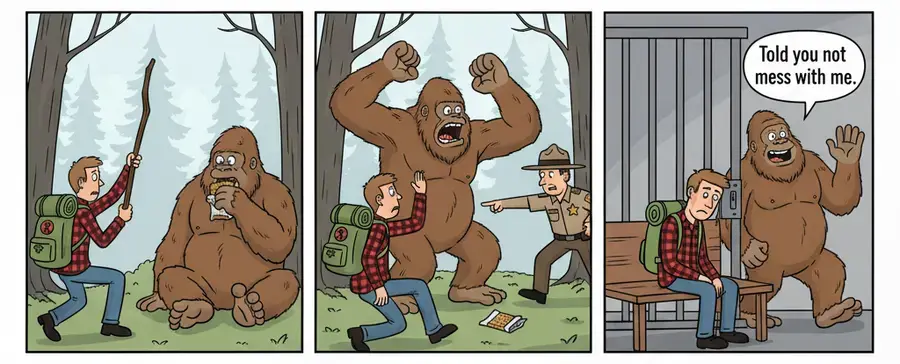
Picture this: You’re hiking through the misty forests of Washington State, clutching a granola bar and humming the X-Files theme. Suddenly, a shadowy figure lumbers between the trees. Is it a bear? A man in a gorilla suit? No—your heart skips—it’s Bigfoot. And just when your fight-or-flight instinct kicks in, Washington State’s legal code comes roaring in with a third option: don’t harass him, or you could end up a felon.
Yes, you read that right. In certain counties in Washington, it is quite literally illegal to mess with Bigfoot, Sasquatch, or any other “undiscovered subspecies.” Forget speeding tickets or jaywalking—if you throw shade at Sasquatch, you could be looking at serious legal trouble.
Wait, Bigfoot Has Legal Protection?
Absolutely. This quirky legal safeguard dates back to 1969, when sightings of the legendary ape-man were sweeping the Pacific Northwest faster than bell-bottom sales. People were pouring into forests with rifles, nets, and cameras, all hoping to bag themselves the monster of folklore.
That’s when Skamania County, Washington, decided enough was enough. In April 1969, county commissioners passed an ordinance declaring the “premeditated, willful, and wanton slaying” of Bigfoot a felony punishable by up to five years in prison. Why? Partly to protect public safety—trigger-happy monster hunters tromping around with loaded weapons are bad for tourism and worse for hikers—and partly, well… just in case Bigfoot is real.
Think about it: If you’re wrong and shoot at some poor, shaggy backpacker, you’ve just committed a crime. If you’re right and shoot an undiscovered species? Congratulations, you’ve just killed science’s greatest discovery. Either way, the county wanted to make sure people thought twice.
A Law That Got Hairier
At first, the ordinance was strict—shooting Sasquatch was treated like attempted murder. But in 1984, after some pushback about punishing people for accidentally mistaking Bigfoot for, say, a particularly woolly elk, the law was softened. The language was changed to declare Skamania County a “Sasquatch refuge.” Harassing the creature, if it exists, would still get you in trouble, but the tone shifted from “Bigfoot is basically a citizen” to “Bigfoot deserves a wildlife preserve.”
And Skamania County wasn’t alone. In 1991, neighboring Whatcom County declared Sasquatch an endangered species. The proclamation noted the creature’s “great scientific value” and promised to protect it from harm. Imagine trying to explain that to your parole officer: “Yeah, I didn’t steal a car or anything. I just… yelled at Sasquatch.”
But Why Protect a Creature We’re Not Even Sure Exists?
Ah, but that’s the charm of it! Bigfoot occupies a rare space in American folklore: part mythical beast, part maybe-real cryptid, part campfire celebrity. For many locals in the Pacific Northwest, Bigfoot isn’t just a legend—it’s an economic engine. Festivals, T-shirts, tours, and even Bigfoot-shaped chocolates pump dollars into small towns. Protecting Bigfoot legally is kind of like protecting Mickey Mouse in Orlando: whether or not he exists, he’s too valuable to let someone ruin the fun.
There’s also a cultural angle. Washington State is famously outdoorsy and a bit eccentric. Enshrining Bigfoot into law says, “We take our myths seriously—and also, we’d rather you don’t fire guns wildly into the forest.” It’s part environmentalism, part tourism strategy, and part cheeky wink at one of the world’s most famous legends.
Bigfoot: Citizen, Legend, or Both?
So, is Washington preparing for the day Bigfoot strolls into the DMV to renew his driver’s license? Probably not. But the law serves as a fascinating example of how folklore can spill into real-world policy. And in a weird way, it’s poetic. Whether Bigfoot is a shaggy man-beast, a misunderstood grizzly sighting, or just a metaphor for “that noise you heard while camping,” Washington has decided he deserves a little legal respect.
The next time you’re hiking in the Evergreen State, remember: you don’t need to worry about bears, cougars, or avalanches nearly as much as you need to worry about this—if you see Bigfoot, keep your granola bar to yourself, smile politely, and for the love of the law, don’t harass him.
Because in Washington, messing with Sasquatch isn’t just rude. It’s a felony.
