The Breath Odor Evaluator: Taking Your Morning Breath Straight to the Face
You know that heart-stopping moment when you wake up, lean over to whisper sweet nothings to your partner, and suddenly realize your mouth tastes like a small rodent died in it overnight? We’ve all been there. Bad breath is a universal human experience, a socially terrifying phenomenon that has derailed first dates and ruined job interviews since the dawn of time.
But while most of us furiously scrub our tongues, pop a peppermint, and pray for the best, a select group of brave souls has turned that pungent puff of air into a highly specialized career. Enter the breath odor evaluator.
Yes, it is exactly what it sounds like. Also known in the clinical oral care industry as an “organoleptic judge” (which is just a fancy, lab-coat way of saying “professional breath smeller”), a breath odor evaluator is a real, actual human being who gets paid to stick their nose near the gaping maws of total strangers. If you’re ever compiling a list of the weirdest jobs in the world, this one easily snags a spot in the top three—right alongside professional armpit sniffers and competitive dog food tasters.
But why does this job exist? In a modern era where we have artificial intelligence that can write symphony scores and rovers currently doing donuts on Mars, shouldn’t we have a robot that can smell a garlic knot?
Well, we kind of do. Scientists use advanced machines like gas chromatographs to measure volatile sulfur compounds (VSCs). These microscopic, smelly molecules are the true villains in the science behind bad breath. There’s hydrogen sulfide (which smells like rotten eggs), methyl mercaptan (which gives off a delightful barnyard aroma), and dimethyl sulfide (which smells like boiled cabbage).
But here’s the unavoidable, non-robotic truth: machines don’t go on blind dates. Machines don’t buy chewing gum at the gas station. Humans do. And the human nose is a brilliantly complex, highly subjective instrument that machines simply cannot replicate.
When a massive oral care conglomerate wants to know how to test mouthwash effectiveness, a machine can only give them the chemical breakdown of the remaining bacteria. A human breath odor evaluator, however, tells them the only thing that actually matters: Does this person’s breath still smell like a dumpster fire on a hot August afternoon?
Imagine the daily grind of this bizarre profession. Your 9-to-5 involves sitting in a sterile, brightly lit laboratory, armed with nothing but a clipboard, an incredibly sensitive olfactory system, and a genuinely ironclad stomach. Test subjects are brought in and specifically instructed to consume the most notoriously offensive foods known to mankind. We’re talking raw onions, crushed garlic, and black coffee—sometimes all at once.
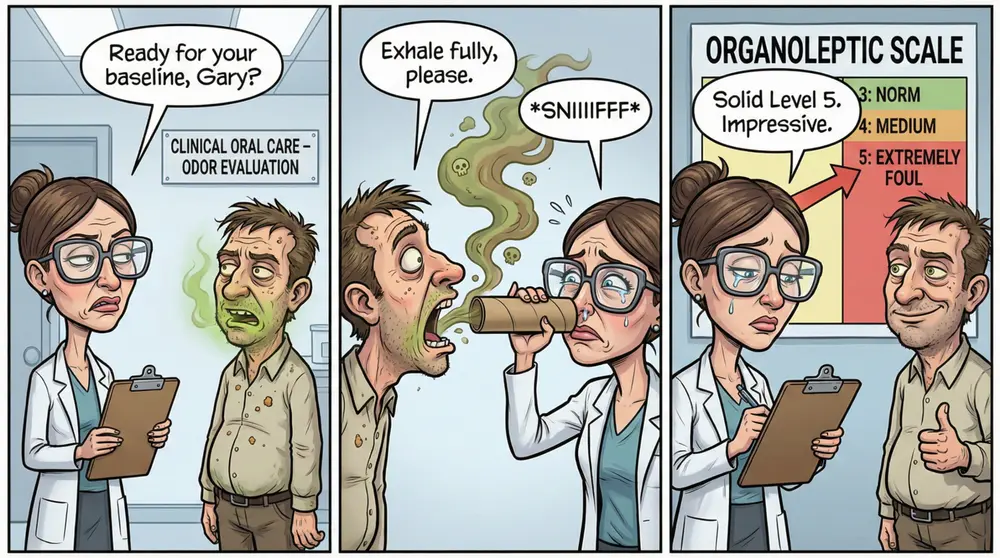
The evaluator leans in. Often, they use a specialized cardboard paper tube to funnel the concentrated, unadulterated oral exhaust directly from the subject’s mouth into their own nostrils. The subject exhales. The evaluator takes a deep, investigative, heroic whiff.
They aren’t just giving a casual thumbs-up or thumbs-down, either. They grade the stench using the Organoleptic Scale, a rigid scientific rating system that ranges from 0 to 5.
- 0: No noticeable odor. (The holy grail).
- 1: Barely noticeable odor.
- 2: Slight, but clearly noticeable odor.
- 3: Moderate odor.
- 4: Strong, offensive odor.
- 5: Extremely foul, eye-watering, call-in-the-National-Guard odor.
Once the baseline stench is recorded, the test subject is handed a prototype toothpaste, a new mouthwash, or an experimental mint. They swish, spit, or chew. Then, the evaluator goes back in for round two. Did that garlic-coffee nightmare drop from a Level 5 to a pristine Level 1? Did the minty freshness last for ten minutes, or did the onion smell come roaring back after twenty? If the product successfully masks the halitosis, it goes to market. If not, it’s back to the drawing board for the chemists, and back to the mouth-funnel for the evaluator.
You might be wondering, “How does one achieve such a glorious position?” You can’t just walk in off the street. Evaluators are rigorously tested for their sense of smell, requiring noses capable of detecting the absolute faintest hints of specific chemical compounds.
Furthermore, their lifestyle must reflect their nasal purity. Before a shift, a breath odor evaluator is generally forbidden from wearing perfume, eating spicy foods, smoking, or even using strongly scented soaps. Their nose must be a pristine, blank canvas, ready to be painted by the colorful, chaotic aromas of a hundred different strangers’ mouths.
It’s a dirty, smelly, undeniably weird job, but it is absolutely essential to the fabric of polite society. Historically, humans have gone to crazy lengths to combat halitosis—ancient Egyptians chewed on boiled honey and cinnamon, while the ancient Romans used mouthwashes made from Portuguese urine (yes, really). Today, we just buy a pack of wintergreen gum for two dollars.
So, the next time you lean in for a kiss with the confidence of a thousand suns, secure in the knowledge that your breath smells like an arctic glacier instead of an onion bagel, take a moment of silent gratitude. You owe your social survival to an unsung hero. Somewhere out there, a dedicated breath odor evaluator took a blast of weaponized halitosis straight to the face—just so you wouldn’t have to.