
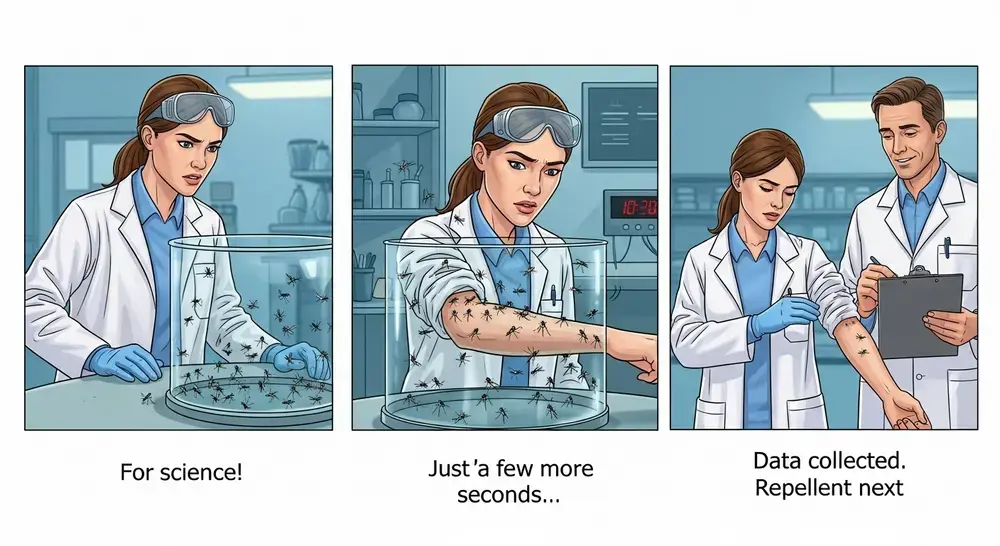
The existence of a mosquito tester makes most people recoil because the job requires one thing: letting mosquitoes feed on you on purpose. The role is simple in description and extreme in execution. A mosquito tester places their own skin in range of a swarm to gather controlled data about biting rates, repellent failures, and environmental triggers.
The core fact stands on its own. A scientist becomes the primary instrument for experiments focused on mosquito behavior laboratory testing. No proxy. No simulation. Actual skin. Actual bites. The reason is technical and practical. Repellents behave differently on living skin than on inert materials. Temperature, sweat, micro-movement, and skin chemistry alter outcomes. To get data that matters, researchers in human mosquito bait research use their own limbs as standardized test surfaces. This eliminates variables that would corrupt measurements and makes each experiment tightly controlled.
The job has a grounded origin. Early entomologists had limited tools. They needed predictable feeding opportunities to map species behavior, track disease vectors, and measure chemical responses. Using their own skin gave them a consistent baseline. When commercial insect repellents entered development pipelines, human testing created the clearest results. It showed how different formulas performed against specific species and under real conditions. Mosquitoes do not follow human convenience; they follow chemical signals and heat maps. A live tester offers both, which makes them a reliable target for insect repellent effectiveness studies.
The cultural reaction to this job is predictable. People assume the role requires an unusual tolerance for discomfort or a disregard for swelling and itching. The reality is more controlled. A mosquito tester works in regulated lab environments, limits exposure duration, and follows strict protocols. They measure bite frequency, observe approach behavior, and document repellent breakdown. Every session generates data on contact patterns, feeding duration, and avoidance changes when chemicals are applied. The tester tracks whether a repellent prevents landings, delays feeding, or produces a partial effect before failing.
Scientific necessity drives the weirdness. Mosquitoes respond to carbon dioxide, body heat, skin bacteria, and chemical vapor signatures. Only a human source produces the complete set of triggers. Artificial lures exist, but they miss nuanced chemical cues. In many species, these cues determine whether the mosquito lands or aborts. The mosquito tester bridges that gap. Their presence completes the biological inputs needed for accurate measurements.
There is a safety structure behind the scenes. Labs track species type to avoid dangerous pathogens. Testers work with non-infectious colonies. Every trial is timed. Exposure ends once enough bites occur to generate meaningful data. Researchers neutralize the mosquitoes after testing to avoid contamination between trials. Measurements continue after the bites. Testers document swelling patterns, delayed reactions, and repellent decay over time. This creates a full picture of human-mosquito interaction.
The weirdness escalates when considering the repetitive nature of the job. A tester may expose the same patch of skin hundreds of times. They rotate limbs to prevent excessive irritation. They catalog variables such as humidity, temperature, and skin oil changes throughout the day. Minor shifts alter how mosquitoes behave. The tester becomes a constant baseline while everything else changes. Their consistency creates clean data that would be impossible otherwise.
The field benefits from these controlled exposures. Improved repellents, better public health strategies, and more accurate mosquito population models originate from this type of data. Mapping how fast mosquitoes land, how strongly they commit to a bite, and how repellents alter that sequence directly informs consumer products. The tester’s discomfort translates into measurable improvements in protection for the general public.
The cultural picture is straightforward. The mosquito tester holds one of the strangest occupations but operates with clear scientific discipline. No mystique. No chaos. Just structured measurement of predictable insect behavior. The shock value comes from the personal involvement required. A role that places the scientist’s own skin into the experiment blurs the line between researcher and instrument.
The unusual nature of the job highlights a broader point. Biological research often requires human variables that cannot be simulated. This job is one of the clearest examples. If an experiment needs exact human chemistry, the human sometimes becomes the apparatus. The mosquito tester represents that principle without embellishment.
The final takeaway is blunt. Modern repellents, disease-vector models, and environmental response systems rely on the work of individuals who willingly offer their skin for measured, controlled mosquito bites. The job is strange, but it exists because nothing else produces data with this level of fidelity.
